
Why Smell Trademarks Are So Hard to Register – and the Cases That Have Beaten the Odds
Trademarks aren't just about names and logos. It's possible to register any "sign" that's associated with a particular business, provided it meets the right legal tests. In the UK, that's included colours (Cadbury's shade of purple), sounds (the Direct Line jingle), and shapes (the classic Coca-Cola bottle). Smells are the hardest of the lot – so rare that each successful registration tends to make headlines.
The Core Problem: How Do You "Show" a Smell?
Under UK and EU law, a trademark has to be represented in a way that's clear, precise, self-contained, easily accessible, intelligible, durable and objective. That checklist comes from a landmark 2002 case, Ralf Sieckmann v Deutsches Patent- und Markenamt, in which an applicant tried to register a scent using its chemical formula, a written description and a physical sample. The court rejected all three: the formula wasn't accessible to ordinary consumers, the description wasn't precise enough, and the sample simply wasn't stable over time.
That ruling has left smell marks almost frozen in the UK and EU ever since. The EUIPO currently treats scent marks as effectively unregistrable, on the basis that there's still no generally available technology capable of representing a smell to the required standard. The UK fares only slightly better, with just two scent marks on the register – both granted before Sieckmann tightened the rules: a rose fragrance applied to tyres (from 1996) and "the strong smell of bitter beer" applied to dart flights.
India Just Found a Way Around the Problem
In November 2025, India's Trade Marks Registry accepted the country's first-ever olfactory mark: a rose-like floral fragrance applied to tyres, filed by Japanese manufacturer Sumitomo Rubber Industries. What makes the case so notable is how Sumitomo solved the representation problem that has stumped applicants elsewhere for over two decades.
Rather than relying on a written description or a chemical formula, Sumitomo's application included a graphical representation of the scent plotted as a vector across seven measurable dimensions – floral, fruity, woody, nutty, pungent, sweet and minty – developed with input from Indian scientists. The Registry accepted this as sufficiently clear, precise and objective, effectively using scientific measurement to sidestep the exact problems the Sieckmann case identified.
Interestingly, Sumitomo wasn't starting from scratch: the very same rose-scented tyre trademark has been sitting on the UK register since 1996, making it the first smell mark the UK ever granted. Sumitomo pointed to that UK precedent to help make its case in India.
Well-Known US Examples
The United States has consistently been the most receptive jurisdiction to scent marks, focusing mainly on whether a smell is functional and whether it's distinctive – rather than demanding a specific representation format. Two well-known examples show how it's done:
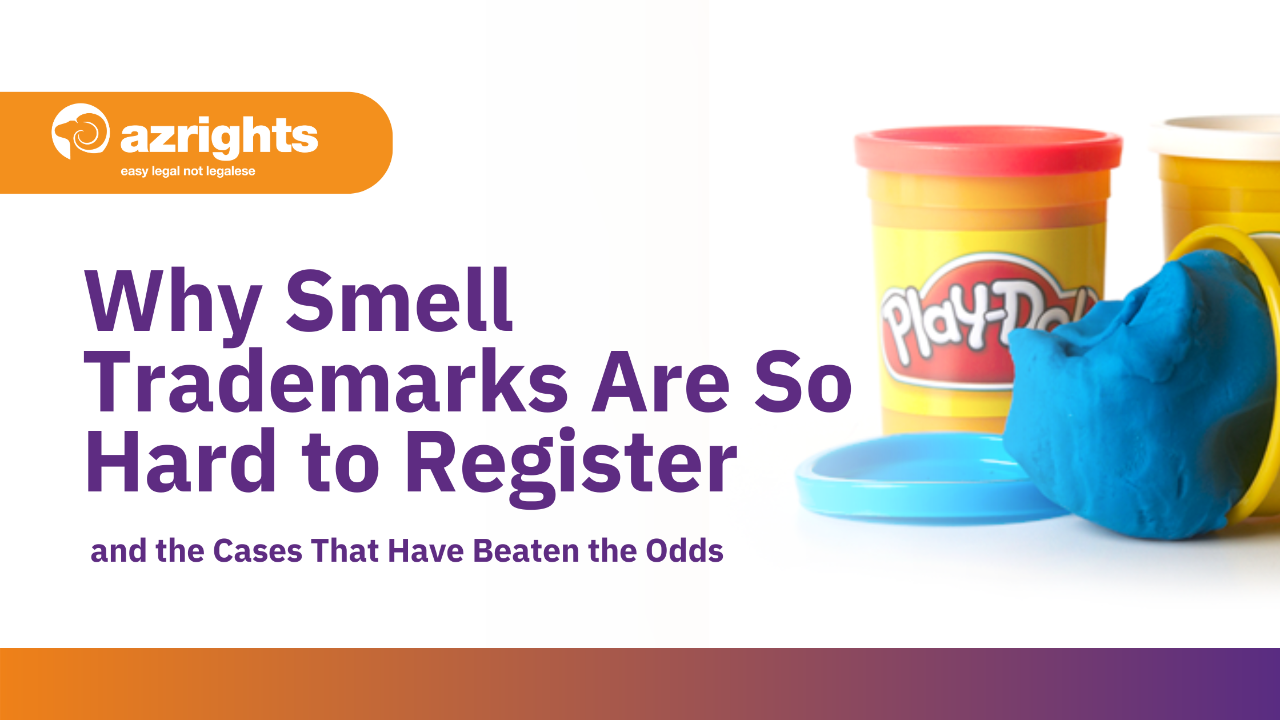
Play-Doh – Hasbro registered the scent of its modelling compound with the USPTO in 2018, describing it as sweet and slightly musky, with vanilla, cherry and salted, wheat-based dough notes. Hasbro had to show the smell was distinctive to consumers and wasn't functional – it doesn't help the dough perform its job.
Crayola – After a six-year battle with the USPTO, Crayola finally registered the scent of its crayons in July 2024. As with Play-Doh, the case turned on proving the smell was genuinely linked to the brand in consumers' minds, rather than simply being a byproduct of the materials used.
Even in the US, though, scent marks remain rare: only around a dozen are currently active on the federal trademark register, alongside oddities like strawberry-scented toothbrushes and piña colada-scented ukuleles.
The Takeaway
Smell marks sit at the outer edge of what trademark law can protect. The UK and EU have been held back for over 20 years by the same representation problem, while the US has taken a more permissive approach and built up a small but genuine track record of registrations. India's 2025 case suggests a scientific route through the representation problem may finally exist – whether UK and EU regulators follow suit remains to be seen.
